-
Victim's Perspective
Introduction & Definitions2 Topics -
Victim/survivor story11 Topics
-
Impact of crime I - Victims' needs and rights6 Topics
-
Impact of crime II – victims' trauma4 Topics
-
Impact of trauma on the victim - 23 Topics1 Quiz
-
EmpathyIntroduction7 Topics
-
The biology of empathy/social neuroscience3 Topics
-
Empathy skills7 Topics1 Quiz
-
Effective CommunicationIntoduction1 Topic
-
Communication Models3 Topics
-
The Importance of Noise2 Topics
-
Non-verbal communication6 Topics
-
Barriers to Effective Communication5 Topics
-
What is Effective Communication?5 Topics
-
Active Listening4 Topics
-
Effective communication skills: Pay attention to nonverbal signals / Keep stress in check5 Topics
-
Effective communication with traumatized victims3 Topics1 Quiz
Participants 1272



Active Listening Practice
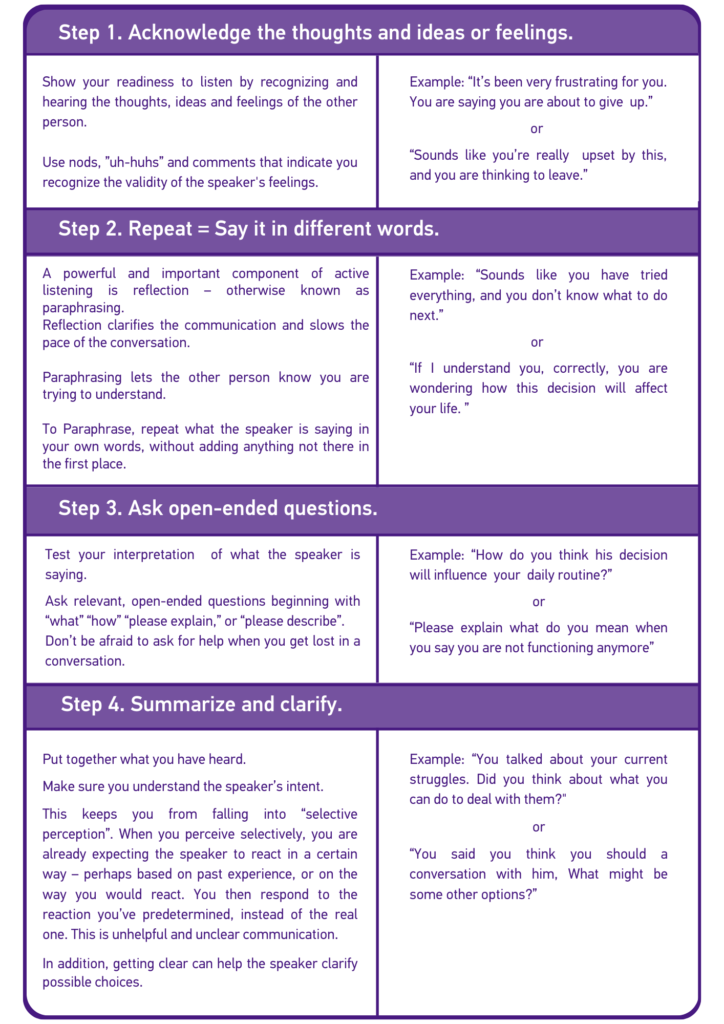
Active listening has to be practiced regularly. The more you exercise active listening in your daily life, the more it becomes a matter of habit, a practice which is naturally part of your communication.
Here is a short paragraph for you to practice active listening. Consider this as part of a dialogue with a speaker. The text below is what the speaker says to you. After you listen (read), you are asked to write (say) active listening responses, based on the information you just learned in the table.
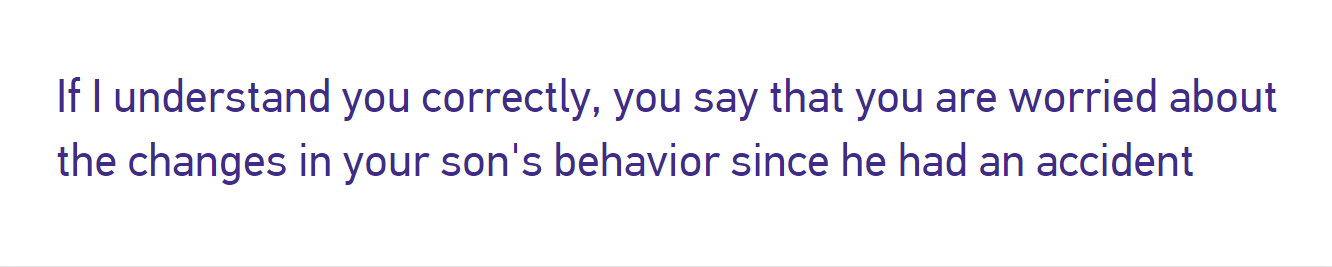
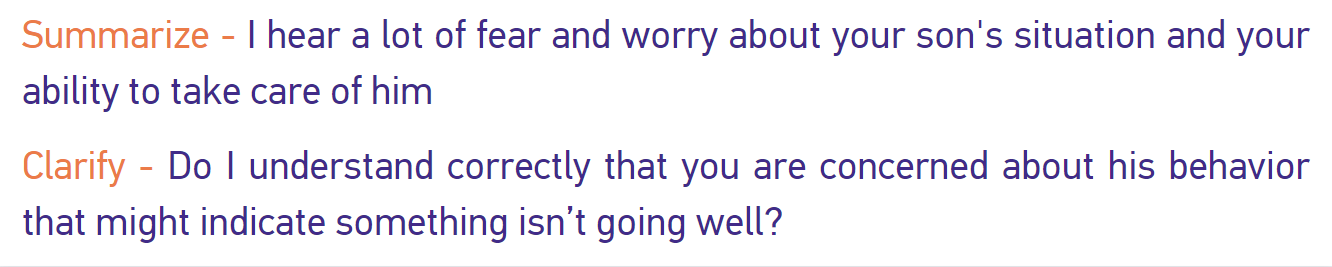
My life took a turn ever since my son had an accident. I feel so insecure about being able to help him and to be his parent. We always had a good relationship, joking around and sharing experiences, but now he is uptight, quiet, hides away in his room all day and doesn’t talk to me at all. For the past month I have literally not slept at night.